



David Larock in Mortgages and Finance, Home Buying, Toronto Real Estate News

Here are the three most important developments last week that related to
Canadian mortgage rates:
European Central Bank (ECB)
Bond-Buying Announcement
The ECB unveiled a new program last Thursday called Outright Monetary
Transactions (OMT) whereby it will provide unlimited buying support for
sovereign bonds in imperiled euro-zone countries. When I read that headline my
first reaction was “Wow”. If the ECB is now prepared to turn on its printing
presses to fight off any spike in euro-zone sovereign bond yields then
speculating on the collapse of the euro would be pointless.
But as has so often been the case throughout the euro-zone crisis, the
details painted a much different picture than the headline:
- Countries which need support for their sovereign bonds must first formally
apply through either the European Financial Stability Facility (EFSF) or the
European Stability Mechanism (ESM). - Any support from these emergency funds will be conditional on an imperiled
country agreeing to strict and grinding new austerity measures. - Heaping more austerity on imperiled euro-zone countries will slow economic
growth and continue to shrink public revenues. This will further exacerbate
government budget gaps, and still more austerity will be required to bring these
expanding deficits back to within agreed upon limits.
Thus, despite Mr. Draghi’s latest podium promise, the vicious cycle between
slowing economic growth leading to ever more grinding austerity remains firmly
intact - and that’s assuming that countries like Germany will even support a
program like this, which is far from a given at this point.
Germany registered the only vote against the new program and several German
politicians vowed to oppose their country’s participation in more bailouts.
Furthermore, this Wednesday the German constitutional court will
rule on whether its government even had/has the legal authority to
participate in the ESM without holding a public referendum. If they rule against
the government, all bets are off.
So what did Mr. Draghi’s announcement really change? In short, not much. The
ECB President had no choice but to back up his previous tough talk about doing
whatever it takes to save the euro with some kind of new initiative. But after
putting the big, grabby headline aside, I think what we really got was
essentially a different shade of lipstick on the same pig.
Now that the question of whether Mr. Draghi has a magic bullet for his
monetary gun has been answered, it is clear that the euro-zone crisis will
continue to drag on. This will stoke continued demand for ultra-safe assets,
like Government of Canada bonds, and that should help keep our mortgage rates
low.
U.S. Employment Data for
August
The U.S. economy created a total of 96,000 new jobs in August, which was
right in line with the average of 97,000 new jobs per month we have seen over
the most recent six-month period. This is well below the 150,000 new jobs that
the U.S. economy needs each month just to keep up with its population growth.
The notable details in the report showed that more than a quarter of the new
jobs created were in the relatively lower-paying bar and restaurant industry and
while the latest average-hours-worked data point was up slightly, average
earnings fell over the same period. On balance then, the average U.S. employee
finished the month with a little less bang for his/her buck, continuing a
disconcerting trend.
To put the U.S. employment situation in perspective, there are now 89 million
working-age Americans who have given up looking for work and the U.S. economy is
still almost 5 million jobs short of its pre-recession peak. This employment
backdrop has coincided with massive federal government stimulus programs, record
budget deficits and unprecedented balance sheet expansion by the U.S. fed. It’s
hard to imagine what the U.S. employment situation would have looked like
without all that government largesse and when this support is inevitably
withdrawn at some point in the future, the U.S. economy will have a new and very
powerful headwind to deal with.
Bank of Canada (BoC) Governor Carney has warned Canadians that our interest
rates will rise sooner than many expect and one of his main supporting arguments
is that the U.S. recovery is on a solid footing. I continue to respectfully
disagree with that view.
Canada Employment Data for
August
Statistics Canada released its latest employment report, showing that a total
of 34,300 new jobs were created in August. While this number was higher than
expected and more than makes up for the 30,400 drop we saw in July, the details
in the report were mixed.
Full time jobs fell by 12,500 and average hours worked also dropped a little.
Normally this would correlate with declining incomes but average earnings
actually increased and this continues an encouraging trend whereby average
earnings have risen by 4% year-over-year so far in 2012.
This wasn’t a bad jobs report (certainly not when compared to the latest U.S.
employment data) but it wasn’t a game changer either. Our economy is still
growing slowly and has plenty of excess labour capacity to absorb before labour
costs pose any significant threat to our inflation rate.
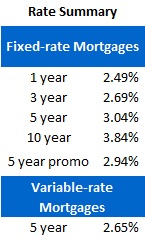 Five-year GoC bond yields were 7 basis points higher for the week, closing at
1.42% on Friday. Lenders left fixed rates unchanged and as such, five-year fixed
rates are still widely available in the low 3% range, with some sub-3%
promotions on offer for borrowers who need to pay for high-ratio creditor
default insurance because they are putting down less than 20% of the value of
their property.
Variable-rate mortgage discounts were unchanged for the week and the best
five-year discounted rate still comes in at about prime minus .35% (2.65%). As
such, I think borrowers who are attracted to the savings offered at the short
end of the yield curve are well advised to consider a one-year fixed rate at
2.49% as an alternative.
The bottom line: I think the three developments discussed above can
be summarized as follows: The euro-zone crisis has no magic fix, the U.S.
employment situation is still dire and while the Canadian employment is
relatively healthy by comparison, it is benign from an inflation perspective.
All of these factors suggest that GoC bond yields, and our mortgage rates by
association, should continue to stay low for the foreseeable future.
David Larock is an independent mortgage planner and industry insider specializing in helping clients purchase, refinance or renew their mortgages. David's posts appear weekly on this blog (movesmartly.com) and on his own blog integratedmortgageplanners.com/blog). Email Dave
Published: September 10, 2012