



One of the questions I get often from buyers is how house prices can remain stable while sales are declining and inventory is increasing?
Many are correctly referring back to their Economics 101 classes where they learnt that a decline in sales and/or a rise in inventory can cause prices to fall - but are forgetting that our starting point matters.
If our market is balanced today and sales fall and/or inventory rises, then prices will likely fall. But what happens when we are starting from a market that is not balanced, like last year when demand and supply were so disconnected that prices were rising 33% per year?
In the case of the market for detached houses, it looks like the decline in sales and rise in inventory has helped move us back to a more balanced market.
We can see this by looking at the balance between supply and demand in the market. The months of inventory (MOI) compares the total number of homes available for sale in a given month against the number of sales in that month. For example, if there are thirty homes for sale and ten houses sell in a given month, we would have three months inventory (an MOI of 3). The higher the MOI, the more likely we are to see downward pressure on prices.
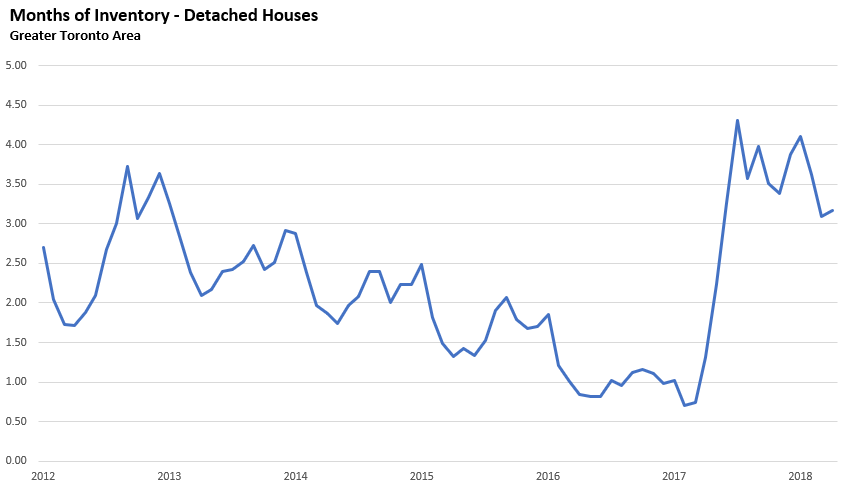
The MOI for detached houses has been declining since July 2017 which has helped bring some stability to the market. We can see from the chart above how rapidly the market reacted to the provincial Fair Housing Plan in 2017 (which included a 15% foreign buyer tax among other measures), when the market went from under 1 MOI in March to over 4 MOI in June, a rapid shift that put significant downward pressure on prices.
It is interesting, and a bit surprising, that we did not see a similar effect on the balance between supply and demand when the mortgage stress tests were introduced on January 1 of this year. The stress tests, which presumably affect a larger number of buyers, should arguably have had a bigger impact on demand for homes than the 15% foreign buyer tax. While sales are down this year, we did not see the rapid change in the balance between demand and supply that we saw last year.
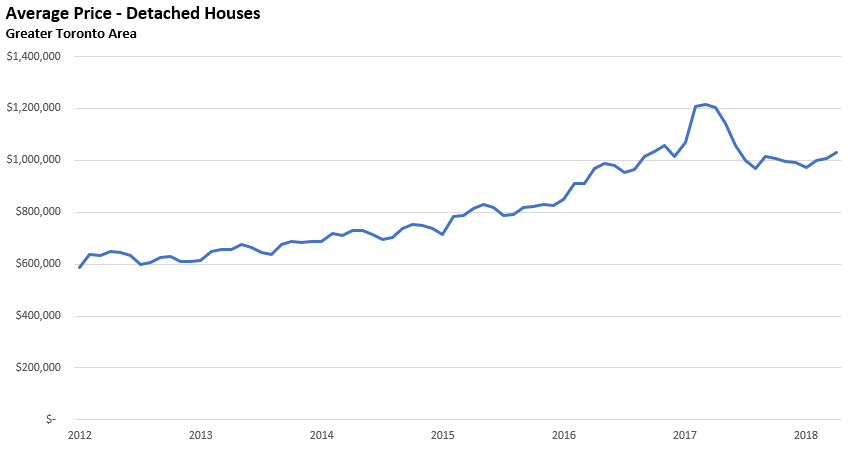
This stability between the supply and demand for houses has helped keep the price of a detached home relatively flat since June 2017.
John Pasalis is the President and Broker of Realosophy Realty Inc. Brokerage in Toronto. A leader in real estate analytics and pro-consumer advice, Realosophy agents help clients buy or sell a home the right way.
Follow John on Twitter @johnpasalis
Published: May 23, 2018