

« Vendors take risk signing SPIS form | Main | The Urban Jungle: Community Gardens Grow on Toronto »

July 29, 2008

TrackBack

TrackBack URL for this entry:
http://www.typepad.com/services/trackback/6a00d83420cedf53ef00e553bd9bfb8833

Listed below are links to weblogs that reference Canada’s Real Estate Market – An International Perspective:

Comments

Vancouver real estate agent

Seems you have put a lot of work effort on this post. I like it. You put it in a way that indeed Canada seems to go against the general RE market downfall. Seems to me that the government did something right, when it restricted the 40 year mortgage.
Over all I think that our British friend is just jealous. I am proud that our economy is doing as it is doing, despite some minor problems.
Jay

Popping Bubbles

KEEP DREAMING... Canadian market is poised to crash hard and the IMF study is fundamentally flawed (it shows U.S. real estate as cheap as of 2006... and since then prices have dropped by 20%). Let's not forget:

a) the fact housing affordability is at its worst level since the last housing bubble burst [RBC. Housing Affordability. Mar-2009, p.1]

b) the fact that real housing prices have increased substantially more than during the last three housing cycles dating back 40-years (all of which ended badly) [Scotiabank. Real Estate Trends, 26-Feb-2008, p.2]

c) the fact that real housing prices in Canada have risen more from trough to peak than in the U.S., where prices and the general economy are now tanking [Scotiabank. Real Estate Trends, 26-Feb-2008, p.2]

d) the fact that Canada's housing prices-to-rent ratio is higher than in any other OECD country save Spain and 90% higher than the long-run trend [OECD Economic Outlook No. 82, December 2007. Data table can be found in the housing price ratio tab of www.oecd.org/.../2483894.xls]

e) the fact that Canada's housing prices-to-income ratio is 32% above historic trends and substantially above the ratio which prevailed when the last housing boom bubble popped in the late 80’s / early 90’s [same source as (d)]

f) the fact that the unprecedented run-up in prices have been fueled by a proliferation of risky lending practices such as (i) a decrease in the required down payment from 10% to 0%, (ii) an increase in the allowed amortization from 25-years to 40-years, (iiI) the proliferation of 7% cash back mortgages and other lending gimmicks (teaser rates, step mortgages, skip a payment, builder rate buy downs, etc.), (iv) the proliferation of home equity lines of credit, and (v) lenders not being on the hook for the vast majority of risky loans they write (CMHC guarantees low-down payment and/or extended amortizations)

g) the fact that studies show typical consumers do not fully understand the implications and risk of low down payment, long amortization and gimmicky (e.g. 7% cash back) mortgages. How many consumers do you think have run a scenario analysis which asks, “what would happen if interest rates went to 8%, 10% or even 12%? What would happen if my partner or I lost our job? What would happen if real estate prices dropped by 10%, 20% or 30%? What impact will extending myself for this house have on my retirement plans?”

h) the fact that housing bubbles around the world are beginning to deflate. By way of example, the UK (admittedly a worse market then ours) mortgage lending in the first quarter is down 40% to the lowest level in 33-years and things are only beginning to get rolling there. In New Zealand housing sales are down 53% year-over-year. And we all can see what is going on in the U.S.

i) the fact that housing construction is far in excess of household formation. CMHC data shows housing starts averaging 226,000 units per year from 2003 through 2007, 33% per year above the roughly 170,000 net new households formed each year [as estimated by TD Economics and others]. Based on housing permits and starts, this trend is expected to continue well into the future.

j) MLS housing inventory is at record highs while at the same time the number of sales is dropping dramatically. For the first six months of the year, listings on the Multiple Listing Service (MLS) reached a record level of 332,958, while sales activity declined to 169,265 units sold. [Globe and Mail Online, July 15, 2008] If the trend of 2 listings coming on the market for every one sold continues, it won’t take long to have 18 to 24 months worth of inventory, a situation similar to the U.S.

k) the fact consumer indebtedness is at record highs relative to disposable income [Vanier Institute. The Current State of Canadian Family Finances. 11-Feb-2008. p.28]

l) the fact that savings rates are close to nil even though the baby boomers should be saving for retirement [Vanier Institute. The Current State of Canadian Family Finances. 11-Feb-2008. p.9]

m) the fact that Canadian incomes have stagnated. Statistics Canada recently reported "that adjusted for inflation the earned income of the ‘average’ Canadian -- the so-called median income - was the same in 2004 as in 1982”

n) the fact that the economy is bordering on a recession. The high Canadian dollar has pounded exports and the U.S., which absorbs some 70% of our exports, is likely in a recession. And what would happen if the rose comes off the construction and commodity bloom? Heresy I know, but both of these sectors are well above trend and are the only real source of strength in the Canadian economy.

o) the fact that inflationary pressures are building, raising the prospect of higher interest costs for borrowers.

I guess it is easier to put on our rose colour glasses, look in the rearview mirror and admire how pleasant the trip has been. Never mind the cliff dead ahead.

Popping Bubbles

Toronto real estate is going to drop by 30%+ over the next few years. The attached statistics on the Toronto housing market show that prices are currently 4.18x the average household income. This is 45% higher than the PEAK of the last major housing bubble in 1989, when only 2.87x the prevailing average income was required to purchase a home in Toronto. And to think that Vancouver is even worse!

http://multimedia.thestar.com/acrobat/50/79/d004eda0453f8443bb506994c2ad.pdf

Dont buy it.

Typical Real Estate Agent hype...

Care to comment on this analysis John? How about being balanced for once?

Housing not just a US problem - July 9, 2008
By Peter G. Hall, Vice-President and Chief Economist, Export Development Canada

http://www.edc.ca/english/docs/ereports/commentary/publications_14965.htm


Doug Porter Economist at BMO: Canada's housing market shows shades of U.S.

http://www.theglobeandmail.com/servlet/story/LAC.20080628.RHOUSING28/TPStory/?query=real+estate

HGM

House prices start to fall in Canada: what’s next?

MacLean’s Magazine

JASON KIRBY | July 23, 2008 |

With housing markets around the world plummeting, many Canadians have been wondering: could it happen here? The first hint of an answer arrived last week with a report showing that house prices in Canada fell in June for the first time in nearly a decade. Now the question has become: is this the beginning of the fall?

According to the Canadian Real Estate Association, the average house price in major Canadian markets dipped to $341,096, down 0.4 per cent from the year before, lead by declines in Calgary, Edmonton and Vancouver. Those numbers surprised economists, who were predicting slower growth, but not an outright decline. “We’ve seen some rapid run-ups in prices and all good things must come to an end,” says Peter Hall, an economist with Export Development Canada. “But this was a surprise. We would not have called for a protracted price contraction.”

Certainly, the dip is nothing compared to the carnage elsewhere. In April, home prices in 20 major U.S. cities tumbled 15.3 per cent from the year before. Home prices are also spiralling in France, the U.K. and Spain.

Still, after a decade of ballooning prices in Canada, even a small decline will have an impact. “It’s all about psychology,” says James Wong, a real estate agent in Richmond, B.C. When buyers see markets cool, “they start to worry that they’re buying at the peak of the market.” They may decide to wait and see if prices will go down further, which slows the pace of purchasing and allows real estate listings to start building up.

Meanwhile, sellers tend to hold out for a while because they’re used to a rising market. Eventually, though, they lower their prices, rather than risk a further drop. Wong is seeing signs of that already, and says the official statistics often lag behind what’s really happening.

From his vantage point on the front lines, Wong predicts Canada will continue to see a slight decline in prices over the next 18 months. Given how bad things have gotten in the rest of the world, many will be hoping that’s as bad as it gets.

http://www.macleans.ca/business/markets/article.jsp?content=20080723_28314_28314

Emma

Interesting analysis but it's clear if you look at the situation of Spain that no matter where a country is on the mortgage market index, a meltdown of the housing market is indeed possible:

http://business.timesonline.co.uk/tol/business/industry_sectors/construction_and_property/article4419056.ece

FGD

Hey there John, your right...the Canadian Real Estate Market is doing fine.


A grim tale of two economies

Jacqueline Thorpe, Financial Post
Published: Thursday, July 31, 2008

TORONTO -- As the figures showed the U.S. economy may have slipped into recession at the end of 2007, more evidence emerged on Thursday that the retreat in Canadian housing is beginning to exact a heavier toll on this side of the border.

Construction activity dropped for a third month in a row in May in Canada while output from real estate agents plunged 16.8% in the month over the year before. Together, activity in the two housing-related sectors fell 4.9% in May from May 2007 -- the biggest slide in a decade of available data.

"Every piece of data we look at, almost without exception suggests the Canadian housing market is turning down," said David Wolf, Canadian economist at Merrill Lynch who ferreted out the housing data from a stream of North American figures released Thursday.

Overall the numbers showed both the Canadian and U.S. economy swinging in and out of negative territory since the end of 2007 as rising fuel costs add another layer of pain for U.S. consumers and fading housing activity weakens what had been solid domestic growth in Canada.

"The figures show a U.S. economy already on the ropes at a point when we face further pain on the road ahead," said Derek Holt, vice-president of economics at Scotia Capital. "Canadian figures show very broad-based weakness, earlier than we would have thought."

Amid the blizzard of numbers, Canadian GDP unexpectedly contracted 0.1% in May, the fourth drop in six months. U.S. GDP expanded an annualized 1.9% in the second quarter, less than the 2.3% rate Wall Street expected. The figure was particularly disappointing given the nearly US$100-billion in tax rebates the government pumped into the economy in the quarter.

Additionally, previous U.S. figures were revised down. The fourth quarter of 2007 was amended to show a 0.2% drop from a 0.6% gain, the first decline since the third quarter of 2001. Growth in the first quarter of 2008 was pared back to 0.9% from 1.0%.

Two consecutive quarters of contraction are required to meet the classic definition of recession but first quarter figures could yet be revised down.

Furthermore, the gold-plated standard rests with the National Bureau of Economic Research which defines a recession as "a significant decline in economic activity" lasting more than a few months, visible in real GDP, real income, employment, industrial production, and wholesale-retail sales.

The GDP contraction added to evidence supporting a recession but regardless of how the numbers turn out, it is clear U.S. consumers are beginning to struggle under the barrage of bad news.

"Unable to meet higher food and energy prices by tapping home equity withdrawals and credit as in the past, Americans are cutting back heavily on discretionary items," he said, noting the 3% drop in spending on durable goods in the second quarter and the weak 1.5% gain in overall consumer spending.

Weakness in Canada is now showing up on the domestic side of the economy after being tilted toward exports and manufacturing at the turn of the year, Mr. Wolf said.

The financial sector is not only dealing with a housing retreat but slumped badly in May amid global market upheaval. In all, the finance, insurance and real estate sector (FIRE) which together accounts for 20% of GDP registered it first monthly drop in four years, Mr. Wolf said.

Despite the surge in energy prices which is supposedly being driven by rising global demand, Canadian natural gas and oil production has weakened since the middle of 2007, Statistics Canada said.

Natural gas inventories have swelled and production fell again in May.

With the bulk of Canadian energy production geared towards North American markets, the slowdown may be further evidence - in addition to a decline in driving trips and retail sales at the pumps - that demand is dropping amid higher prices, Mr. Wolf said.

In all, analysts still expect the Canada to report growth in the second quarter after a 0.3% contraction in the first quarter but the going will be tough in both economies as U.S. fiscal stimulus wears off.

Financial Post

jthorpe@nationalpost.com

http://www.financialpost.com/reports/story.html?id=693216

John Pasalis

Popping Bubbles,
An interesting conclusion:

"the IMF study is fundamentally flawed (it shows U.S. real estate as cheap as of 2006... and since then prices have dropped by 20%)"

but I’m not sure if your analysis adds up. The IMF report used Q3 2007 data for the US housing price analysis, not 2006 data. Secondly the report does not show US real estate as “cheap”, it actually shows it as overpriced by around 4%. You should also check your sources, I’m not sure who told you that US home prices dropped by 20% but this is far from the truth. According to the Office of Federal Housing Enterprise Oversight US prices in the third quarter of 2007 were down 2 ¼ percent from their peak in 2006.
I think I’ll pass on fact checking items a) through o)


Don’t Buy It,
If you feel my analysis is unbiased and “Typical Real Estate Agent Hype”, I suggest you read some of my previous posts.
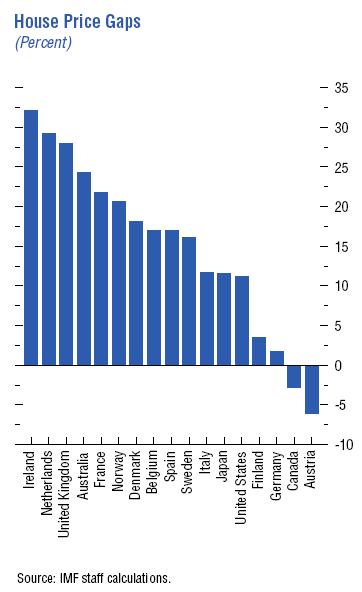
I have been cautious about our real estate market for some time now. Everybody knows that the real estate market is slowing down in Canada. The IMF report doesn’t paint a rosy picture for Canada’s real estate market; it simply offers an international perspective. Had we been in Ireland’s position where more than 30% of our house price appreciation was unexplainable, then we would have more reason to worry. The fact that we are at the other end of the spectrum gives us reason to believe that the appreciation in our real estate market wasn’t just speculation but was based on some fundamental economic factors. That’s all.

Don't Buy It

John,

For someone who claims to know his Real Estate statistics, you don't get your facts straight. Home values in US have fallen 18.4 percent since the peak in July 2006 according to the Standard & Poor's/Case-Shiller 20-city index. The Office of Federal Housing Enterprise Oversight Report is inaacurate since it does not include subprime mortgages.


S&P: Home prices drop by record 15.8 pct. in May
By J.W. ELPHINSTONE – Jul 29, 2008

NEW YORK (AP) — Home prices tumbled by the steepest rate ever in May, according to a closely watched housing index released Tuesday, as the housing slump deepened nationwide.

The Standard & Poor's/Case-Shiller 20-city index dropped by 15.8 percent in May compared with a year ago, a record decline since its inception in 2000. The 10-city index plunged 16.9 percent, its biggest decline in its 21-year history.

No city in the Case-Shiller 20-city index saw price gains in May, the second straight month that's happened. The monthly indices have not recorded an overall home price increase in any month since August 2006.

Home values have fallen 18.4 percent since the 20-city index's peak in July 2006.

Nine metropolitan cities — Las Vegas, Miami, Phoenix, Los Angeles, San Diego, San Francisco, Seattle, Wash., Portland, Ore., and Washington, D.C. — posted record declines in May. And the value of housing in Detroit is now lower than it was in 2000.

But a possible bright spot in an otherwise dismal report, seven metros — Tampa, Fla., Boston, Detroit, Minneapolis, New York, Dallas and Atlanta — showed smaller annual declines.

Las Vegas recorded the worst drop, with prices plunging 28.4 percent in the month. Miami came in a close second, with prices down 28.3 percent.

Charlotte, N.C., posted the smallest drop at 0.2 percent. Until April, the North Carolina city had been the last metro still showing price gains.

http://ap.google.com/article/ALeqM5hL1BztOWFNmmcLQ6aOP-BAz9FlMgD927JC180

John Pasalis

Don’t Buy It,
Thank you for your comment. Unfortunately we appear to read statistics a little differently.

I’m not sure how prudent it is to say that house values nationally in the US have declined by 18% based on a decline in a 20 city index. The problem of course being that the data is a) true for just 20 cities and b) is an index.

The S&P/Case Shiller index has idiosyncrasies we need to be mindful of. The most obvious problem with the index is that it excludes all co-ops and condominiums from its calculations. This of course presents a problem in most major cities that have a high proportion of condos and co-ops. How accurate can the index really be in a city like New York? So to be more accurate, the index is not a Housing Index but rather a Freehold Housing Index.

The National Association of Realtors on the other hand publishes average price data for all homes regardless of if they are freehold, co-ops or townhomes.
http://www.realtor.org/research/research/ehsdata

As of June 2008 the NAR report shows that the average price for a house in the US declined by 6.8% over the previous year.
http://realosophy.typepad.com/IndustryReports/NAR_June2008.pdf

So why the discrepancy? I suspect it has to do with the S&P/Case Shiller methodology. In addition to excluding condos and co-ops, it excludes any home that has been substantially renovated by the current owner. Up and coming neighbourhoods that are appreciating in value due to home owners renovating their properties probably wouldn’t have as much of an impact on the S&P/Case Shiller index.

John Carle

Hi John;

First off... thanks for the post. There aren't a lot of people who are willing to say good things about the markets these days. And the value of real estate in Canada is still strong; despite a short-term downturn in values. Folks; the sky is NOT falling. It seems to me that the "dooms-day" crowd are the only ones talking out there!

I am a Realtor in Edmonton, Alberta. So I know a thing or two about the real estate market and where it has been, where it is, and where it is going.

I'd like to point out a few things.

1. Short term statistics are always wrong. you can't measure real estate in the same way that you measure stock markets. We don't have a "ticker tape". Every house is different, so you can't say "the average house went up/down 5% this month."

2. Real estate is always a safe investment. IF you do it right, that it. Buy a property for cash-flow and you'll be safe. People have lost their money because they're buying with negative cash-flow in the homes of value gains. They lost because they couldn't weather a downturn. Things go up, things go down. But over the next 20 years... you'll make lots of money. make sure your investment properties have cash-flow, and you can then relax about the market values. Cause in 20 years it will have climbed dramatically and you'll be the guy saying "I bought that house for a quarter of what kids are paying today..."

3. It amazes me how many people will post their opinions, but won't put their real names to it. If you're going to be anonymous... then shut up. If you don't value your opinion enough to put your name to it; then why should anyone else?

John Carle
ReMax Real Estate Edmonton
www.knock-knock.ca

P.S. For the record... I don't make more money when prices are climbing. So that doesn't influence my opinion one bit.

Popping Bubbles

John P...

HA HA HA!!! I have to admire your dellusional mind. Despite your weak defence, the IMF report is certainly proving wrong for Canada so far.

As for your comment that "I think I’ll pass on fact checking items a) through o)", could that be because they don't support your dellusion?

Get ready for a lean 2009. It is too bad that your profession requires painting a misleading and incomplete picture of the housing market, particularly given that most families' life savings are on the line.

tribaldos real state corp

Panama, the new Miami for Latin American and European

Panama has become in recent years into the new Miami not only for
Latin Americans but also for many foreigners in 5
years, either for work, business or retirement, have decided to invest and
installed in the country to hold presidential elections on Sunday.
However, all facilities that Panama has made the investment and
Residents have also brought new collateral problems such as crime
organized drug trafficking.
According to data migration between 2004 and March 31, 2009 were legalized
in Panama about 45,000 foreigners, of whom 45% are Colombians
(11,400), 12% U.S. (5,403), 9% Chinese (4,174), Venezuela 7%
(3,065) and 5% Dominicans (2068).
The most striking has been the Venezuelans, who in the past
4 years have tripled their presence in Panama, to create communities
whole of that nationality.
According to authorities, the economic, air facilities, the
dollar, safety, climate, and the expansion of the Canal
have provided many people in Colombia, Venezuela and United States
have decided to come to Panama to invest to stay.
"This is a new Miami for Latin Americans, but I'm sure
for Europeans, too, for the facilities offered and that in Panama
other foreign countries can not, "he told AFP Tayra Barsallo,
Deputy Director of Immigration.
The official explained that "many retired Americans or Canadians
Panama Europe have also chosen to install.
Residence permits have become a source of income for
Panamanian government, which in the first quarter raised over
$ 4 million for this purpose, double in the same period
last year.

For more information

http://www.tribaldos.com.pa

Verify your Comment

Previewing your Comment

This is only a preview. Your comment has not yet been posted.

Working...
Your comment could not be posted. Error type:
Your comment has been posted. Post another comment

The letters and numbers you entered did not match the image. Please try again.

As a final step before posting your comment, enter the letters and numbers you see in the image below. This prevents automated programs from posting comments.

Having trouble reading this image? View an alternate.

Working...

Post a comment

Profile

Realosophy

Search This Blog