



« Revisiting the Emerging Neighbourhood | Main | Media Roundup - August 15th 2008 »

August 14, 2008

TrackBack

TrackBack URL for this entry:
http://www.typepad.com/services/trackback/6a00d83420cedf53ef00e553e340be8833

Listed below are links to weblogs that reference Toronto's Real Estate Market - Are Things as Bad as They Seem?:

Comments

CinToronto

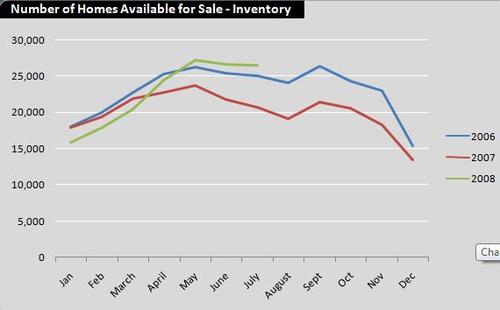
John: I want to respect you. Honestly, I do. You are far more analytical than most real estate agents. But I must complain about this sudden rush to compare to 2006. It is true that 2007 was an anomaly (although I don't recall many TREB members cautioning this at the time). It is also true that compared to 2006, inventory numbers are up by a far smaller margin. But it would be more balanced to also report that inventory has been steadily increasing for a number of years, and has not been at this level since 1991.

Toronto realtor

The inventory is indeed up. Way up, partly due to the coll down on the market, but have you seen the new building developments lately? Investors are building like crazy. Condos being built all over the place. That is also a reason why inventory is so up. But the prices on the new buildings are so high, that no one is willing to buy. But still I keep saying that all this is normal compared with 2006. It`s just the hyperactive 2007 that gives everyone so much to rant about. I really don`t understand why is everyone just talking about it. They all have good advice but no one does anything about it.
Julie

CinToronto

Julie: New condo inventory has nothing to do with resale home inventory, unless you are arguing that the presence of all of these new condos is reducing the sale of resale homes. Please, real estate agents, learn your subject matter.

Don't Buy It

Home prices continue slide

Globe and Mail

August 14, 2008 at 12:49 PM EDT

Weakness in the Canadian housing market deepened as resale home prices slid, sales fell and listings surged last month.

The 3.6 per cent drop in the average existing-home price is a continuation of a price decline that started in June, when the average price dropped by 0.4 per cent, the first decline in more than nine years.

The average price of a Canadian resale home stood at $327,020 at the end of the month, compared with $339,277 in July, 2007, according to the latest report by the Canadian Real Estate Association

“Canada's housing market is running into some seriously foul weather amid the weakest affordability in nearly two decades,” Doug Porter, deputy chief economist at BMO Nesbitt Burns Inc., said in a research note.

A sharp drop in consumer sentiment has helped drive sales activity down 10.9 per cent from the year before, and the latest figures drive home the impact that excess supply is having on prices, Mr. Porter said.

Prices fell by the most in Calgary, which experienced a 7.8 per cent drop over the year before. In Edmonton prices slid by 5.3 per cent. Other markets in which prices fell included Windsor-Essex, a region hard hit by the auto manufacturing sector slump, and Trois-Rivières, Que., which has a small sales base.

A notable newcomer to the list, however, was Greater Vancouver, where prices edged down 1 per cent last month compared with the year before to $575,256.

Prices in Victoria, by contrast, rose by 5 per cent, following a slight decline in June.

Sales levels have been edging up slightly since bottoming out in February, although activity stands below the levels hit in record-breaking 2007. Sales rose by 0.1 per cent month-over-month in July to 26,033 units on a seasonally adjusted basis.

Actual sales however, at 27,889 units, were down 10.9 per cent from the year before, which was the strongest July on record.

Sales fell in Montreal, Toronto, Victoria and Ottawa compared with the month before, but rose from June levels in Edmonton, Calgary, St. John's, Saskatoon, Halifax and London, Ont. In Winnipeg, sales in July broke previous monthly records.

Listings also remained near record levels in July, with 50,782 properties for sale in major markets in July. That's the second highest level on record, and down a slight 0.2 per cent from the peak hit in May.

Listings reached their highest level on record in the country's largest market, Toronto, where prices rose by a scant 1.5 per cent from the year before. Listings were also near peak levels in Saskatoon, Montreal, Gatineau, Trois-Rivières, Montreal and Victoria.

Mr. Porter, who has raised concerns activity in Canada could be echoing that of the U.S. housing market, said the depth of the downturn is unlikely to mimic that south of the border.

“While we still doubt that Canada will stage an instant replay of the trauma in U.S. markets, even a mild version would be bad news,” he said.

http://www.reportonbusiness.com/servlet/story/RTGAM.20080814.wmls0814/BNStory/Business/home

John Pasalis

CinToronto,

With respect to your comment
"It is true that 2007 was an anomaly (although I don't recall many TREB members cautioning this at the time)."
I suggest your read my post titled Extended Amortizations and Toronto's Real Estate Market: Real Opportunity or Bubble Booster? I was quite concerned about the sudden demand in Toronto's real estate market.
http://www.movesmartly.com/2007/09/is-torontos-rea.html

You are right, inventory has certainly been on the rise since 1991 but that is to be expected since sales have also been on the rise. If the inventory wasn't keeping up with the increase in demand for housing than we would have had bigger problems.

When looking at inventory, the actual number isn't as important as the ratio of sales to inventory on the market. I'll expand on this next week.

CinToronto

John: You changed the topic. Your whole article was about inventory, not the sales/inventory ratio. Please see the graph your Prudential colleague has charting inventory at the torontothegood.com site. Sales have not been rising since 1991. They dropped in '92 and '93, most of 94, and all of 95, and didn't really return to pre-crash levels until much later in the 1990s. The sales/inventory ratio was also dismal until '97, with one short exception. Sales/inventory tells us more, but inventory does tell us something.

CinToronto

One last fact: The 2008 sales/inventory peak (around 32%) is the lowest peak since 1996 and 1997. Please don't just talk about 2006 when you do your sales/inventory article.

John Pasalis

Sure, inventory may not have been on the rise since 91, but it has been on the rise over the past ten years.

The point of my article was not to do a twenty year historical analysis of Toronto's real estate market but rather to demonstrate that when we read about big changes in inventory or sales, we need to be a little cautious. Was the base year or the current year the anomaly? Or was it a bit of both?

Truth or Talk

I think the writing is on the wall when it comes to the Toronto property market. Using flat price assumptions it does not pay to buy over rent. I expect that once people realize prices are no longer rising (and they're in fact falling on a month-to-month basis since April*), the tide will really start to turn.

* I haven't seasonally adjusted and would be curious if anybody's done that.

Real Estate Bear

Ontario house prices set to follow Western drop

Globe and Mail Update

August 14, 2008

Ontario will likely follow major cities in Western Canada into a house price decline, but while its slide should be shallower it will also be more worrisome due to the province's weaker outlook, an economist says.

Last month the average price of a resale home in Canada fell by 3.6 per cent, continuing a decline that started in June when prices lost ground for the first time in more than nine years, according to data released Thursday by the Canadian Real Estate Association (CREA).

So far the drop in average home values has mainly radiated from Calgary and Edmonton, where prices fell by 7.8 per cent and 5.3 per cent respectively in July from the year before.

But it wouldn't be surprising to see prices in these and other large Western cities slump by as much as 20 per cent in the near term, in a correction of markets that got ahead of themselves, said Benjamin Tal, senior economist at CIBC World Markets Inc.

“You don't have to be an economist to predict that prices will go down in Saskatoon and Regina, but in terms of the fundamentals, all the pieces there are still fine – a healthy economy, energy boom and rising food prices,” Mr. Tal said. “Other than people who bought last year thinking prices would keep doubling over breakfast, most people there [the Western provinces] should still end up ahead.”

More concerning is the softening real estate market in Ontario, he added.

Hard hit by the auto sector slump, Windsor-Essex became the first major market in the province to post year-over-year house price declines. Now Toronto also appears headed for a drop, with prices rising a scant 1.5 per cent last month, while sales fell by 12.4 per cent and new listings surged by 17.8 per cent.

“The concern here is that the potential decline in Ontario would not reflect overshooting, but instead the further slowing of an economy that is probably already in recession,” Mr. Tal said.

“While I would expect a more modest drop in prices of about 5 per cent in Ontario and the GTA, prices have not risen as much here and the decline would be more painful.”

In July the average price of an existing home fell by 3.6 per cent from the year before, building on a 0.4 per cent drop in June, according to CREA.

The average price of a Canadian resale home stood at $327,020 at the end of last month, compared with $339,277 in July, 2007.

A sharp drop in consumer sentiment helped push sales activity down 10.9 per cent from the year before, and the latest figures drive home the impact that excess supply is having on prices, Doug Porter, deputy chief economist at BMO Nesbitt Burns Inc., said in a research note.

“While we still doubt that Canada will stage an instant replay of the trauma in U.S. markets, even a mild version would be bad news,” Mr. Porter said.

Listings also remained near record levels in July, with 50,782 properties listed for sale in major markets in July. That's the second highest level on record, and down a slight 0.2 per cent from the peak hit in May.

A newcomer to the list of markets experiencing price declines was Greater Vancouver, which had a 1 per cent year-over-year to an average of $575,256 in July.

While nationwide sales levels have been edging up slightly since bottoming out in February, activity stands below the levels hit in record-breaking 2007. Sales rose by 0.1 per cent month-over-month in July to 26,033 units on a seasonally adjusted basis.

Actual sales however, at 27,889 units, were down 10.9 per cent from the year before, which was the strongest July on record.

Sales fell in Montreal, Toronto, Victoria and Ottawa compared with the month before, but rose from June levels in Edmonton, Calgary, St. John's, Saskatoon, Halifax and London, Ont. In Winnipeg, sales in July broke previous monthly records.

Listings reached their highest level on record in the country's largest market, Toronto. Listings were also near peak levels in Saskatoon, Montreal, Gatineau, Trois-Rivières, Montreal and Victoria.

The government's recent decision to crack down on mortgage lending rules has likely fed the cooling of the real estate market, helping Canada avoid a U.S.-style bubble, Mr. Tal said.

Most Canadian cities are now in, or on the cusp of, being in buyers' territory, he added.

While home prices are softening, however, this is not expected to offset rising inflation, he said.

“If food and energy continue to rise, housing will not save us,” Mr. Tal said.

http://www.reportonbusiness.com/servlet/story/RTGAM.20080814.wmls0814/BNStory/Business/home

Anon

Truth or Talk,

Check this out:

liesmybrokertoldme.blogspot.com

Properties in Brazil

Hi

The result goes to fell down sale of the real estate in Toronto because the prices of real estate are very high.

The comments to this entry are closed.

Profile

Subscribers

Subscribe

  • Subscribe by email:

Facebook Fans

Toronto Real Estate Statistics

Realosophy

Search This Blog