March 12, 2008

Caribou Park

Jesse in Toronto Neighbourhoods

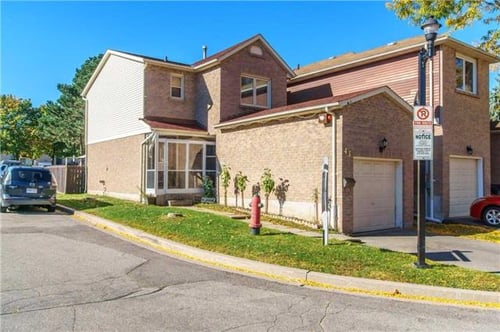
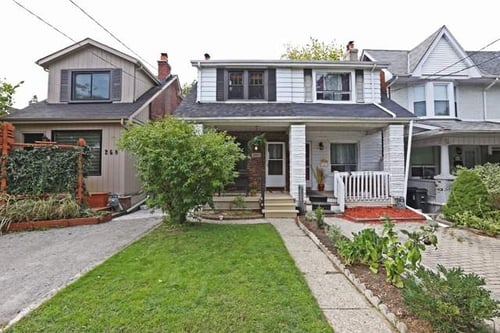
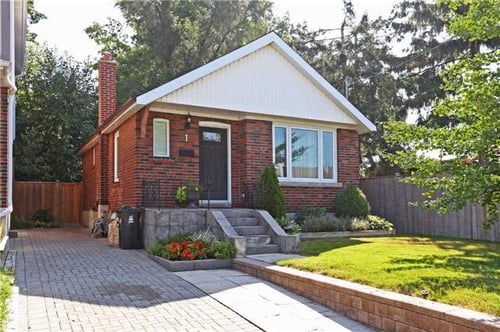
Joining Allenby and Corso Italia is yet another of Toronto’s smaller areas, the neighbourhood of Caribou Park (check out Realosophy’s Neighbourhood Profile for stats in housing and schools).  Hidden within larger neighbourhoods, Caribou Park is contained within the borders of Lytton Park, Glen Park and Ledbury Park.  On land that once was part of the Snider Family Farm (circ. 1800s), Caribou Park is now almost exclusively residential.Dsc00692_2

As with many large tracts of land that were held within Toronto’s city limits, the Snider Farm changed hands and was sold to developers by the 1940s who continued building until the 1960s. A mix of two-storied homes and bungalows were built along streets with names such as Coldstream Avenue, Otter Crescent and Caribou Road which bisects the neighbourhood; a few low-rise buildings are located along Lawrence Avenue West. Caribou Park homes are reminiscent of the styles and designs that can be found on Toronto Island - where the variety of finishes and facade choices differ from house to house, they all manage to add to the consistency of the area.  As with any neighbourhood, there are clusters of houses that were built with the same floor plans (this is assumption, I have only seen the outside) but HomeOwners have added touches here and there so no two homes are really alike.


Continue reading "Caribou Park" »

October 04, 2007

What Would Jane Jacobs Think? Expanding Toronto's Underground PATH

Urmi in Neighbourhoods, Lifestyle, In the News

Path Plans are underway to expand Toronto’s PATH system.  Developers and planners would like to extend the network of underground walkways keeping the downtown commercial district warm.  New condos and schools coming into the area would be linked in.  More shops would line the streets lit with florescent tubes. Commuters would buzz about, tourists would continue to get lost in the poorly-signed maze, undesirables would be kept out and the streets would fall silent at night and on weekends. Could this be that vision for Toronto we’ve desperately been searching for—climate-controlled Fraggle Rock equipped with an off-switch?

The Toronto Star’s recent coverage of the issue doesn’t fail to mention the late Jane Jacobs, a prolific researcher of city life and the rule of thumb by which we measure city planning (though many of her followers find this easier said than done).  The wonderful thing about Jacobs is that she is that rare author whose original work is better than any reference to it (this post included).  The lucidity of her writing, particularly her 1961 classic, The Death and Life of Great American Cities, reveals a progressive yet unyieldingly practical approach to urban issues.

Path_blog_picjane_jacobs_book_4 Chronicling the deteriorating urban cores and greying suburban areas of 1950s America, Jacobs detailed the secrets of successful cities. City life attracts us because we adore our privacy and anonymity—and the freedom of social and material mobility that comes with it. Strangers keep us safe.  We meet in what Jacobs terms "the sidewalk" which is any public space—park, shops or bus stops—where we enjoy functional relationships with unknowns who help us take care of our basic needs (getting food, driving us around and watching us walk home safely).  It is the absence of strangers ("eyes on the street") willing to act on our behalf that makes us nervous, not the presence of them.

Continue reading "What Would Jane Jacobs Think? Expanding Toronto's Underground PATH" »

October 03, 2007

The Village at York: Toronto Neighbourhood Explorer

Jesse in Neighbourhoods, Neighbourhood Explorer

York University’s Keele campus is a daunting collection of all that is academia.  Student housing complexes tower over low-rise, classroom-filled buildings.  York Lanes Shopping Center lies on the eastern outskirts and points the way to the immense, five-floor Scott Library.  York University opened its doors on this campus in 1965 and the building styles, earthy interior and exterior colours reflect the trends of that decade.  Additional buildings have been added over the past forty years, expanding the campus to reflect ever-increasing student enrollment.  The amalgamation of these buildings provides an architectural timeline that flows throughout the grounds.  My first year at York was a cycle getting lost, re-orienting myself and running to my next class, only to exit out of a different door and thus beginning the cycle once more.  I carried a campus map with me at all times. 

A few years ago, a portion of the southern campus was sold to Tribute Communities and development was underway.  Large semidetached homes sprung up and seemed to create a little community amongst themselves.  During my second year at York, I decided to explore this little enclave since I was no longer getting lost on a daily basis.         

Front_11

'The Village at York' is the moniker given to this collection semidetached and fully detached homes that line the handful of streets north of the Keele Street-Finch Avenue West junction.  In what Tribute has tagged a 'Traditional Urban Neighbourhood', residences are reminiscent of houses in Toronto's downtown core.  Rear garages along laneways and tall, narrow designs are the standout similarities. Balconies protrude from various planes of elevation - many of these homes are three stories - and there are numerous windows which allow for copious amounts of natural light to flow inside.  Decorated in muted earthy and light stone colours, the homes are appealing to the eye and exude an air of comfort.

Continue reading "The Village at York: Toronto Neighbourhood Explorer" »

September 27, 2007

Guildwood: Toronto Neighbourhood Explorer

Jesse in Neighbourhoods, Neighbourhood Explorer

Few neighbourhoods hold my fascination as Guildwood does (see Realosophy's Guildwood neighbourhood profile for local school and housing stats).  I have always made time to stroll through Guildwood Park, especially in the spring and fall months.  Losing myself somewhere between the shores of Lake Ontario and Kingston Road has always been a favourite pastime of mine.  Guildwood (or The Guild) has a century-old history which is ever present in Guildwood Park and endlessly satiates my need to read every historical plaque I see.  It is easy to forget that you are in the heart of Scarborough while navigating the streets during an evening stroll or searching amongst Guildwood’s seven parks for your favourite spot.

Continue reading "Guildwood: Toronto Neighbourhood Explorer" »

September 12, 2007

Dreaming the Big Dreams in Toronto: New Urbanism, Smart Growth and High-Density Development

Urmi in Neighbourhoods, Lifestyle, Condos, In the News

Urban planning enthralls me, like so many others, because it holds out that tantalizing promise of agency, that assertion that we can choose how we live, and live better for it.  The movement of the moment, “New Urbanism,” also called “Smart Growth,” is part revolution, part return to the past—or specifically, a past in which we lived closer together, walked out to main street to work and gathered at local watering holes.  The Government of Ontario calls its particular vision of high-density growth "Places to Grow."  The expert planners and architects who have envisioned ‘compact living’ have done so for some time now; European (and to a lesser extent, American) cities of the past provide inspiration.  For many, the Industrial Revolution and the invention of automobiles for the masses, mark the break between the time we lived close to our livelihoods and the time we sprawled away from the factories that polluted town centres.  Living in a different era, we want to return to a former point in time, to live the life we have imagined from old records and photographs of the past.

There is no doubt that 'high-density living,' with a modern twist of mixed-use and eco-friendly planning, would contribute positively to the way we live in Toronto.  This type of development would accommodate not only different groups of people in the same space, but the different activities they get up to in it.  Benefits would include decreasing traffic, reducing pollution and diminishing the isolating effect that sprawl has on many individuals and families.

But it also strikes me that we have always wanted to improve the way we live, and that we have always longed for a distant past.  In the closing lines of his masterwork, The Great Gatsby, F. Scott Fitzgerald once pit the sheer exuberance of an America (here, one can safely substitute North America) faced with the prospect of transforming wide open spaces into one dream or another, against the sheer barrenness of the task at hand:

Gatsby believed in the green light, the orgastic future that year by year recedes before us. It eluded us then, but that’s no matter—to-morrow we will run faster, stretch out our arms farther. . . So we beat on, boats against the current, borne back ceaselessly into the past.

Fitzgerald’s words are often read as an indictment of the ultimately futile ‘American Dream,’; I read it instead as an ode to our need to strive, regardless of where it gets us.

Continue reading "Dreaming the Big Dreams in Toronto: New Urbanism, Smart Growth and High-Density Development" »

September 06, 2007

Forest Hill: Toronto Neighbourhood Explorer

Jesse in Neighbourhoods, Neighbourhood Explorer

Growing up in a suburb east of Toronto, I was unaware of the weight some neighbourhoods carried when their names were uttered. “You moved where?” gasped Lisa, in a voice somewhere between disbelief and awe.  I had mentioned that my new condominium was on the third floor of ‘Forest Hill Lofts’, a three-year old converted factory whose history captivated me much more than the name of the building.  Images of Toronto’s stuffy upper crust were thrown at me along with a general consensus that I, in my mid-twenties, along with my partner in his early thirties were unimaginably young to afford a home in -gasp- Forest Hill (see Realosophy's Forest Hill neighbourhood profile for local school and housing stats). 

In a previous post, I mentioned that we did not research our new neighbourhood before we bought, innocently believing that we had moved into what seemed to be a much-revered area. My building’s moniker could not be false advertising, could it?  After looking into Toronto neighbourhood boundaries, I realized that a more accurate name for my new home should be ‘Next to Forest Hill Lofts’ as I live in Fairbank, on the western side of Forest Hill.  Curious to see if the stereotypes were true, I recently dove into Forest Hill and found that it is anything but the uptight picture that was painted whenever I mentioned its name.

Continue reading "Forest Hill: Toronto Neighbourhood Explorer" »

August 29, 2007

Is Toronto the Most Successful Multicultural City in the World?

Urmi in In the News, Neighbourhoods, Lifestyle

Humans, it seems, can never get enough of parlour games—Monopoly, Scrabble, Name the Most Successful Multicultural City in the World.  My sister recently sent me a message about the latter in the form of a BBC simulcast debate between radio stations in Toronto, New York, London and Sydney.  “I know it’s silly, but I can’t help it,” she wrote from New York, and I knew what she meant—we had once watched a whole episode of Judge Judy together, cackling at the rhetorical train wreck.

Before one even gets to the ‘most successful’ part, how do we measure the magnitude of the challenge?  Is diversity a culture, language, religion, race, sex or class thing?  If referring to immigration, does one mean the city with the largest foreign-born population, or one with a population from the greatest number of other places?  Many stats, PhDs and call-ins peppered the BBC debate.  But how exactly does one measure an individual’s experience with diversity?  Does one have to encounter diversity in every New York neighbourhood, not just Queens, and if one sits next to diversity on the subway in Toronto, does one have to interact with it for it to count?  Do we take off points for race riots, anti-diversity radio rants, the quiet trashing of a plate of exotic treats one just cannot stomach at the latest food festival?  Given the lack of data (or too much of it saying nothing), we substitute in our own anecdotes: “My own Aunt Jemima came here from the South and met Uncle Ben in a lonely rice shop.” And so on.

Continue reading "Is Toronto the Most Successful Multicultural City in the World?" »

August 20, 2007

Glen Park: Toronto Neighbourhood Explorer

Jesse in Neighbourhood Explorer, Neighbourhoods

Glenparka2 Almost at the foot of the Allen Road Expressway lies a quiet collection of houses just south of Lawrence - the neighbourhood of Glen Park (see Realosophy's Glen Park neighbourhood profile for local school and housing stats).  Had I not moved into the adjacent neighbourhood, I would never have known it to exist.  When looking for my first home, I neglected to do some background research about the neighbourhood in which I desired to live.  As the moving truck came and went and my overstuffed boxes became broken-down stacks for recycling, I felt that karma was going to rear its cosmic head in the neighbourhood department.  Were all my door-holding good deeds going to pay off or was my pre-school people biting phase finally going to catch up with me?  Luckily, my adopted neighbourhood of Fairbank turned out to be a hidden marvel, along with its sister area, Glen Park, which is located two streets north of my front door.  Nestled amongst busy traffic routes and plazas, Glen Park is remarkably quiet and retains the slower-paced neighbourhood streets that are usually found in suburban communities.

Continue reading "Glen Park: Toronto Neighbourhood Explorer" »

August 13, 2007

South Annex: Toronto Neighbourhood Explorer

Urmi in Neighbourhoods, Neighbourhood Explorer

Ed. Note.  Kicking off a day of free celebrations at Bathurst and Bloor this past Sunday, Mayor David Miller officially declared August 12 "Ed Mirvish Day" in Toronto.  In honour of a man who truly believed in the value of Toronto as a community, we explore a neighbourhood forever changed by ‘Honest Ed’ (1914-2007). 

The story of the parking lot that never was and the legend that was cemented in its wake serves as a reminder: life is little happenings strung together. 

Following the passing of Toronto's retail and theatre impresario extraordinaire, Ed Mirvish, media obituaries detailed his thwarted attempt to convert the properties surrounding his eponymous discount emporium into a giant parking lot for his customers.  When the city prevented the American émigré of Jewish Lithuanian descent from realizing his vision of concrete convenience, Ed took up his artistic wife Anne’s suggestion and created Mirvish Village, a collection of lovely buildings with low rents suited to art galleries and other creative endeavours. 

As a U of T undergraduate bunking down at nearby Trinity College, I was a regular visitor to the South Annex (see Realosophy's South Annex neighbourhood profile for local school and housing stats).  As the tributes began to pile in, I began to wonder anew about Ed’s neighbourhood: does the circus and roses atmosphere still mesmerize? 

Continue reading "South Annex: Toronto Neighbourhood Explorer" »

August 10, 2007

Toronto Island: Paradise Lost?

Jesse in Neighbourhoods, Neighbourhood Explorer

Ed. Note.  Neighbourhood Explorer is a regular feature in which our intrepid adventurer presents an up close-and-personal tour of a Toronto neighbourhood.

Kids flourish in the most unique settings, day camp being one of the very best.  I have spent my summer negotiating deals with little climbers who have inevitably gotten themselves stuck in trees trying to get a better view of anything they might be missing in the ground.  While laying out my bargaining chips one by one (promises of story-telling and never-ending camp songs), I often find myself wanting to climb up that very same tree to take in the surroundings.  If camp were in any other location, the fascination would not be as great - but we are on Toronto Island.  Everything about the island – the homes, methods of transportation and pace of daily life – differ from anything else you'll find in the city.

Continue reading "Toronto Island: Paradise Lost?" »

Profile

Realosophy

  • Realosophy Vertical Banner